How UPI Redefined India's Financial Landscape
The Unified Payments Interface has revolutionized India's financial landscape through a sophisticated digital ecosystem that connects banks, fintech companies, and millions of users. This comprehensive analysis targets business leaders, product managers, fintech professionals, and technology strategists seeking to understand how UPI's infrastructure drives commercial success and industry transformation.
UPI's rapid adoption stems from its robust technological foundation and strategic stakeholder partnerships. The platform processes billions of transactions monthly, creating new revenue streams and reshaping traditional banking models. Financial institutions, payment service providers, and merchants have discovered innovative ways to monetize UPI's capabilities while delivering enhanced customer experiences.
This exploration covers three critical areas: UPI's core digital infrastructure and the technology components that enable seamless real-time payments, key stakeholders and revenue models that power the ecosystem's growth and sustainability, and business transformation patterns across industries with measurable economic impact metrics. These insights reveal how UPI's digital ecosystem creates value for businesses while driving India's transition toward a cashless economy.
Understanding these interconnected elements helps organizations identify strategic opportunities, optimize their digital payment strategies, and leverage UPI's infrastructure for competitive advantage in an increasingly digital marketplace.
Understanding UPI's Core Digital Infrastructure
Real-time Payment Processing Architecture and APIs
Think of UPI as a high-speed, invisible post office where millions of "money envelopes" are delivered in under a second. At its heart is a master conductor (the NPCI) that ensures every bank and app speaks the same language. This "universal translator" relies on a few key protocol components that keep the conversation flowing:
- Transaction Initiation Standards: These act like a universal template, ensuring every payment request is formatted and sent correctly.
- Authentication Mechanisms: This is the digital "handshake" that establishes secure and verified user access.
- Message Routing Protocols: Think of this as the GPS, making sure your money reaches the exact right account without getting lost.
- Settlement Procedures: These are the behind-the-scenes rules governing how funds actually move between different banks.
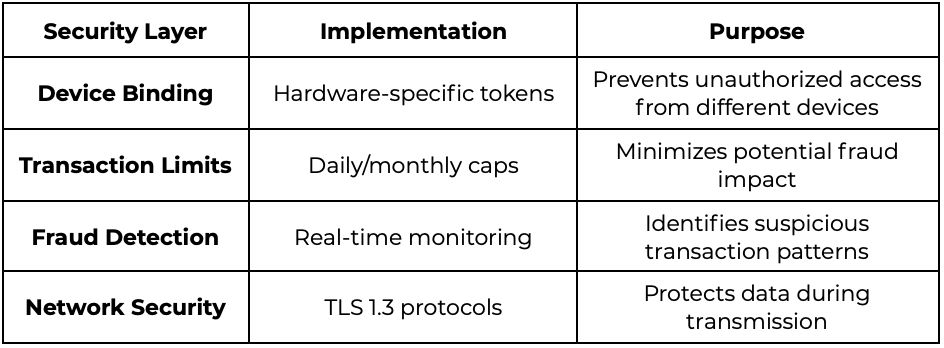
Security here isn't just a feature; it’s a "digital deadbolt." By combining something you have (your phone) with something you know (your PIN), UPI ensures your money stays yours. Behind the scenes, smart AI acts like a silent security guard, watching for fishy behavior in real-time.
Whether it's a quiet Tuesday or a massive holiday sale, the system uses cloud technology to "stretch" its capacity, handling over 10 billion monthly transactions without breaking a sweat. It’s complex engineering made to feel completely human and effortless.
Multi-layered Security Protocols and Encryption Standards
Security is the bedrock of UPI, built like a digital fortress with multiple layers of defense to keep your money and personal data safe. At its core, it uses high-level "secret codes"—specifically AES-256 and RSA-2048 encryption—to scramble your information so that only the sender and receiver can understand it.
Instead of just a password, UPI uses a "double-lock" system. It pairs something you know (your secret PIN) with something you have (your specific smartphone). Because each transaction is tied to your unique device, a hacker can’t simply log in from another phone to steal your funds. To stay one step ahead, smart AI "security guards" work in the background, constantly scanning for odd behavior and blocking suspicious attempts before they can do any harm.
Business Transformation Across Industries
Retail Sector Embracing Cashless Payment Solutions
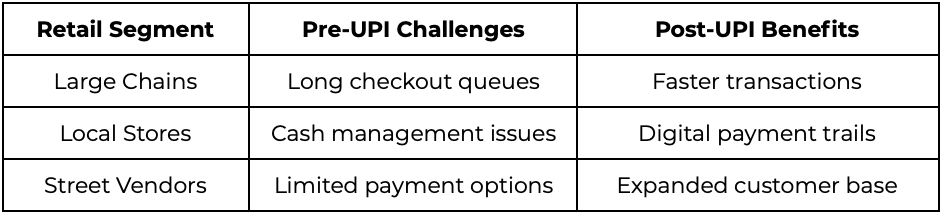
The retail landscape has traded bulky cash drawers for simple QR codes, making "do you have change?" a phrase of the past. From gleaming malls to corner kiosks, UPI has stripped away the friction of physical currency, solving issues like counterfeit notes and tedious manual accounting. Large retailers have slashed queue times by integrating UPI directly into their checkout systems, while small street vendors have gained their first-ever digital footprint. This shift doesn't just make buying faster; it makes businesses smarter by turning every "ping" of a successful payment into a valuable data point for growth.
The retail landscape has traded bulky cash drawers for simple QR codes, making "do you have change?" a phrase of the past. From gleaming malls to corner kiosks, UPI has stripped away the friction of physical currency, solving issues like counterfeit notes and tedious manual accounting. Large retailers have slashed queue times by integrating UPI directly into their checkout systems, while small street vendors have gained their first-ever digital footprint. This shift doesn't just make buying faster; it makes businesses smarter by turning every "ping" of a successful payment into a valuable data point for growth.
Retail Segment Transformation
UPI has turned paying into a "blink-and-you-miss-it" experience. For e-commerce, it’s a conversion engine, killing cart abandonment by replacing scary redirects with a simple PIN. For small businesses, it’s a bridge to the big leagues; that digital paper trail acts as a "financial fingerprint," turning "invisible" vendors into "investable" entrepreneurs who can finally qualify for loans. Even service providers, like tutors or freelancers, have escaped the "check is in the mail" trap. By ensuring instant payment the moment a job is done, UPI makes the entire financial world feel more human, reliable, and connected.
By bringing banks, fintechs, and technology partners together via a smooth, API-driven stack, UPI has completely transformed the financial services industry. Instantaneous, safe transactions are made possible by this infrastructure, opening up revenue through value-added goods and merchant services.
Beyond payments, UPI has democratized digital tools, lowering operating costs and enabling small businesses to compete with large corporations. Customer satisfaction has significantly increased in sectors like retail and healthcare by incorporating real-time processing. For businesses that take advantage of this strong digital ecosystem, the transition to a cashless economy offers sustained growth as transaction volumes increase exponentially.