Is Being An Introvert A Weakness?
Many of us have grown up hearing the same kinds of comments - "Why are you so quiet?" or "You need to come out of your shell." These messages, well-intentioned as they sometimes are, carry a quiet assumption: that introversion is something to be overcome.
But what if that assumption deserves a closer look? What if introversion isn't a flaw to be corrected, but simply a different - and genuinely powerful - way of moving through the world? That's the conversation this piece wants to open up.
💬 Reflect: Think back: has anyone ever suggested you needed to be "more outgoing"? How did that land for you at the time?
First, Let's Understand What Introversion Actually Is
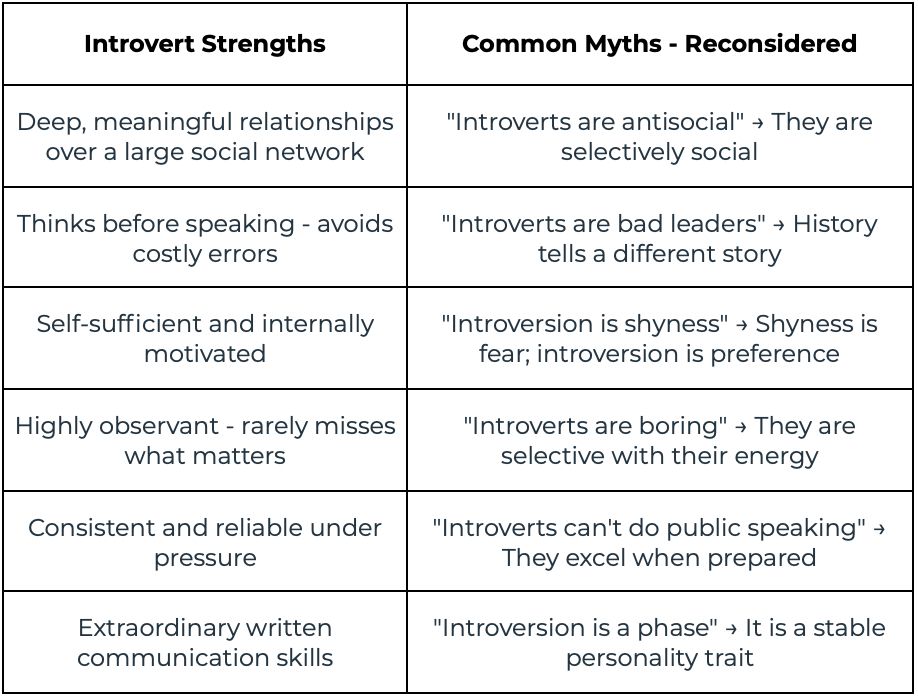
It's worth clearing up a common confusion right at the start: introversion is not the same as shyness, and it is not a form of social anxiety. Psychologist Carl Jung, who first brought the term into wider use, described introversion simply as a preference for the inner world - thoughts, feelings, ideas - over the external world of constant activity and stimulation.
Neuroscience has added an interesting dimension to this. Research by Dr. Elaine Aron and others suggests that introverts tend to have higher baseline arousal in the cerebral cortex, meaning they require less external stimulation to feel fully engaged. It's not that social situations are unpleasant - it's that a quiet room with an interesting problem can be just as energising.
"Introversion is not a lack of engagement with the world. It is a particular way of engaging with it."
What the Research Suggests
- Introverts make up an estimated 30–50% of the global population (Susan Cain, Quiet, 2012)
- Studies suggest introverts tend to outperform extroverts in academic settings on average
- A Harvard Business Review study found introverted leaders often deliver stronger outcomes with proactive teams - because they create space to listen
- Multiple studies show introverts score higher on reflection, persistence, and precision
💬 Reflect: Does this description resonate with your own experience? What's one situation where your preference for depth over breadth has actually worked in your favour?
The Cultural Lens We've Been Looking Through
Susan Cain's book Quiet makes a compelling case that Western culture - particularly in the US
- has gradually elevated extroversion into a kind of social ideal. Over the last century, the cultural shift moved from what she calls a "Culture of Character" (built around integrity, discipline, and inner life) toward a "Culture of Personality" (built around charm, magnetism, and presence).
This shows up in everyday structures: open-plan classrooms that reward group participation, open-floor offices that make quiet focus difficult, social media feeds where the most visible voices are often mistaken for the most valuable ones.
None of this is evidence that extroversion is superior. It's evidence that many of our systems were designed with a particular style in mind. That's worth sitting with, because it raises an interesting question:
💬 Reflect: If our environments were designed differently - with more space for deep focus, thoughtful communication, and independent reflection - how might that change who we perceive as "talented" or "leadership material"?
"The introvert's quiet is not emptiness. It is density - a rich internal world where ideas are shaped and refined before they reach the surface."
The Strengths Worth Talking About
Deep Thinking and Focused Work
In a world of constant distraction, the ability to sit with a complex problem - to think it through fully before reacting - is genuinely rare. Cal Newport, in his book Deep Work, argues that sustained, uninterrupted focus is becoming one of the most valuable skills of the 21st century. For many introverts, this is simply how they naturally operate.
Listening as a Leadership Skill
There's a real difference between waiting for your turn to speak and actually listening. The latter builds trust, surfaces insights, and creates the kind of environment where the best ideas -regardless of who they come from - can actually be heard. Many of the most effective doctors, negotiators, therapists, and managers in the world share this quality.
Emotional Intelligence and Observation
Because introverts tend to spend more time observing before acting, they often develop a finely tuned awareness of the people around them - noticing shifts in tone, hesitation before an answer, the gap between what someone says and how they seem to feel. This kind of attentiveness has real value in almost every human context.
Creativity and Independent Thought
A striking number of history's most significant breakthroughs came from solitude rather than committee. Darwin walked alone for hours on what he called his "thinking path." Newton was in isolation when he developed his foundational theories on gravity and calculus. Solitude, for many people, is simply where original thought tends to happen - not because being alone is magical, but because the space it creates allows ideas to develop without interruption.
💬 Reflect: Which of these strengths do you most identify with? And has it ever been misread by others as a weakness?
A Few Names Worth Knowing
It's easy to assume that the most visible figures in history were also the most outgoing. But a closer look reveals a different picture. Albert Einstein spoke openly about how solitude stimulated his thinking. Barack Obama is widely known for his deliberate, measured communication style and his preference for smaller gatherings. J.K. Rowling created an entire fictional universe largely alone, in quiet cafés.
Bill Gates famously takes solo "Think Weeks" - periods of complete isolation for reading and reflection. Mahatma Gandhi, one of history's most transformative leaders, was described by those who knew him as soft-spoken and deeply introspective. Rosa Parks' quiet, dignified refusal to give up her seat changed the course of civil rights history. Malala Yousafzai, a global icon of courage, is thoughtful and internally driven in her approach.
"In a gentle way, you can shake the world." - Mahatma Gandhi
💬 Reflect: Who is an introvert in your own life - a colleague, a teacher, a mentor -whose quiet impact you might not have fully noticed until now?
Introversion in the Workplace: A Different Perspective
Corporate culture has long tended to reward visibility over depth - the person who dominates a meeting is often assumed to be the sharpest in the room. But the research points in a more nuanced direction.
A study published in the Academy of Management Journal found that introverted leaders generated 14% higher profit from proactive employees compared to extroverted leaders in the same conditions. The suggested reason: they listen more, they don't need the last word, and they create conditions for the best ideas to surface - whoever those ideas belong to.
As organisations continue to grapple with automation, AI, and the realities of remote work, the qualities increasingly valued are deep expertise, written communication, independent problem-solving, and emotional intelligence. These happen to be areas where many introverts have been quietly building strength for years.
Where Introverts Often Thrive at Work
- Written communication - emails, reports, strategy documents
- Deep-focus work: research, coding, writing, design, analysis
- One-on-one conversations - mentoring, counselling, consulting
- Independent judgment - less susceptible to groupthink
- Remote and asynchronous work environments
- Thorough decision-making - more information processed before acting
💬 Reflect: Think about your own workplace: are the systems in place built for performance in meetings, or for quality of output? Which genuinely matters more in your role?
The Energy Equation - Working With Your Nature
One of the most practically useful things to understand about introversion is how energy works. Extroverts tend to gain energy from social interaction; introverts tend to spend it. Neither is a flaw - they're simply different operating systems. The important thing is knowing which one you are, and designing your life and work accordingly.
This doesn't mean introverts can't be social, perform in public, or lead large teams. It means they tend to need intentional recovery time - solitude, quiet, undisturbed thought - to return to their best. Treating that need as a weakness is a bit like criticising a long-distance runner for stopping at a hydration station.
"You don't need to change who you are. You need to change who you think you should be."
Some practical approaches that many introverts find useful: scheduling recovery time after high-drain events like conferences or large social gatherings; protecting a block of deep-focus time each morning; preparing thoroughly before interactions, which reduces the social energy needed in the moment; and - perhaps most importantly - releasing the habit of apologising for needing quiet.
💬 Reflect: Where in your current routine are you not protecting your energy? Is there one thing you could do this week to change that?
Relationships - Depth Over Breadth
Introverts tend not to collect acquaintances. They invest in a smaller number of relationships -and those relationships tend to be marked by real depth, loyalty, and authenticity. The introverted friend is often the one who remembers what you mentioned in passing six months ago, who thinks carefully before offering advice, and who doesn't compete for space in a conversation.
In romantic relationships, too, introverts often bring a particular quality of presence - a willingness to engage with what is real rather than what looks good, a comfort with silence, a depth that performative connection rarely reaches.
💬 Reflect: Who in your life offers this kind of depth - quiet, attentive, genuinely present? Have you told them what that means to you?
From Liability to Strategy - A Shift Worth Making
Many introverts spend years trying to pass as extroverts - forcing small talk, attending events that drain them, performing enthusiasm they don't feel. The exhaustion is real, and the results tend to be poor. More importantly, the cost to self-esteem over time can be significant.
The shift that tends to change things is less about behaviour and more about framing. Instead of asking "How do I become more extroverted?", the more useful question might be: "How do I design a life where my introversion is genuinely an advantage?"
Practical Starting Points
- Own your preparation habit - showing up thoroughly ready is a quiet form of confidence
- Master written communication - let your ideas do your talking for you
- Build a reputation for depth, not volume - be the voice that carries weight
- Choose environments that suit you - not every job, city, or social circle has to be loud
- Create before you consume - morning solitude is often the most productive time
- Find your fellow introverts - they exist at every level, in every field
- Let your listening be your leadership - you'll be trusted where louder voices are not
💬 Reflect: What would it look like to stop managing your introversion as a liability -and start treating it as a deliberate strategy?
The World Needs the Quiet Ones
We live in an age of noise - where every platform rewards the loudest voice, the fastest take, the most urgent reaction. In this environment, the introvert's instinct - to pause, to think, to speak only when there is something worth saying - is not a disadvantage. It is increasingly rare, and increasingly valuable.
The world's most enduring books were written in solitude. Its most significant scientific breakthroughs were conceived in quiet rooms. Many of its most transformative movements were led by people who didn't shout - they simply refused to be silent about what mattered.
"Your introversion is not your cage. It is your craft - the lens through which you see what others miss, feel what others skim past, and build what others only talk about."
So the next time someone asks why you're so quiet - take a moment. You might just be thinking.
💬 Final reflection: What's one thing about your introversion that you've been apologizing for - that you might instead start owning?