India at 79: Celebrating Decades of Progress and Charting the Path to 2047
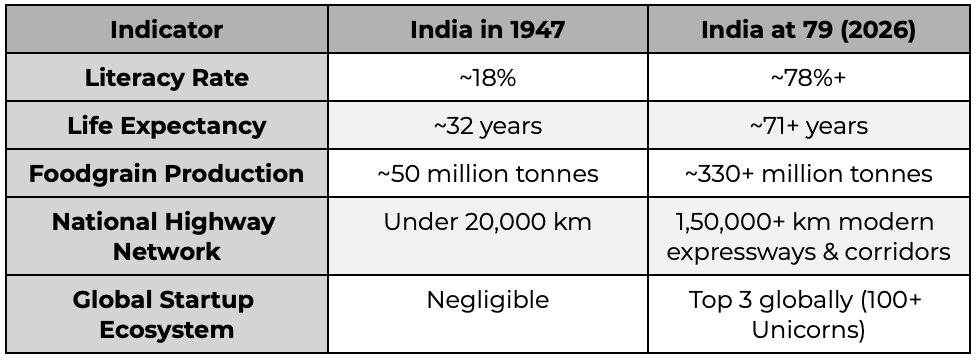
On August 15, 2026 India will complete 79 years of independence. From a poor , famine-prone colony in 1947 to the world’s sixth-largest economy and a global digital powerhouse today, India’s path feels like one of those most extraordinary shifts in recent history, you know, the kind that doesn’t happen often.
And as we’re only 21 years away from the centenary moment of Viksit Bharat 2047, this anniversary is not only a chance to applaud our hard-earned gains but also an urgent push to deal with socio economic boundaries that still need clear, decisive moves.
At IES Management College and Research Centre (IES MCRC), Mumbai, we look at this landmark in a practical way, through the lens of strategic leadership, economic resilience, and nation building.
4 Key Shifts : How India Has Changed (1947–2026)
Macroeconomic Rise & Global Standing
Back in 1947, India’s share of global GDP was less than 3%, weighed down by colonial deindustrialisation and that legacy really hurt. Now, India acts like an engine for worldwide growth, powered by sturdy domestic demand, service exports, and a widening manufacturing footprints under efforts like Make in India.
Digital Public Infrastructure That Leads the World
India has, opened technology to the masses at a scale many countries have never managed:
- The “India Stack”: Aadhaar, UPI and Account Aggregator have pulled hundreds of millions into formal banking and everyday commerce.
- Fintech strength: India handles billions of real-time transactions every month, ahead of several advanced economies combined in digital payments.
Food Security, Pharma & Scientific Innovation
- Agricultural Resilience: The Green, White, and Blue Revolutions helped India move away from a “ship-to-mouth” food habit into a global agricultural exporter.
- Pharmacy of the World: India produces essential generic medicines and vaccines, that protect public health across the globe, quietly yet consistently.
- Space & Deep Tech: From landing on the lunar South Pole to homegrown satellite deployment, ISRO has established world-class cost efficiency and scientific prestige.
Modern Physical Connectivity & Infrastructure
Big investments under the PM Gati Shakti master plan rebuilt the country’s logistical spine, with dedicated freight corridors, stretched expressway networks (Bharatmala) and better port links (Sagarmala) and world class regional transport systems like Vande Bharat trains.
4 Critical Frontiers India Must Strengthen Going Forward
To move from a lower-middle-income nation into a fully developed high-income superpower by 2047, the strategic mind-set has to shift, away from surface progress and into deeper structural frictions:
Boosting Female Labor Force Participation (FLFP)
Even if women’s education enrolment has climbed quite a lot, actual workforce participation still looks like a kind of silent growth engine that is not fully switched on. Creating safer urban ecosystems, equal workplace policies, and flexible career pathways is essential to unlocking multi-trillion-dollar economic potential.
Upgrading R&D Investment and Deep-Tech IP
India’s Gross Expenditure on R&D (GERD) is still under 1% of GDP, while advanced economies tend to sit closer to 2–3%. If India wants real technical sovereignty, it has to pull in more private capital for semiconductor fabrication, artificial intelligence, biotechnology, and quantum computing. That way, the country generates global intellectual property, not just consumes it.
Bridging the Industry-Academia Employability Gap
With one of the world’s youngest populations, harvesting the so-called “demographic dividend” means continuous, and practical skilling. Higher education has to match what industry wants right now - so, data analytics, ethical leadership, and sustainable business models should be integrated, rather than treated like side lessons.
Climate Resilience & Sustainable Urbanisation
Rapid migration into cities is putting real pressure on air quality, water security, and everyday waste handling. To stay on a stable growth track, India needs climate-smart urban systems, stronger circular economies, and faster renewable deployment - like the Green Hydrogen mission and the Solar push.
The Role of Management Education in Building 'Viksit Bharat'
Nation building in the modern era is moving because of capable, ethical, and forward looking business managers. Even today, when things feel very complicated, like managing supply chains that are not so simple, or steering the shift toward green energy, or pushing entrepreneurial ventures forward, management graduates end up holding the practical levers of execution.
At IES Management College and Research Centre (IES MCRC), Mumbai, our curriculum is made on purpose to shape leaders who can handle these macro economic turns without panicking.
- Value Driven leadership: putting business ethics, corporate governance and sustainable development into the daily thinking.
- Analytical and tech know-how: bringing AI, FinTech, and operations analytics right into the heart of management subjects.
- Industry immersion: giving experiential learning, live projects and hands on exposure to problems that are both operational and social in real life.
And now, as India steps into 79 years of freedom, the mission for the next set of managers feels straight forward: turn potential into performance and guide the country with confidence toward its centenary era.
Frequently Asked Questions
What is the ‘Viksit Bharat 2047’ vision?
Viksit Bharat 2047 is India’s master roadmap aiming to become a fully developed, high-income nation by the time of its independence centenary in 2047. It keeps the focus on economic growth, social progress, environmental sustainability, plus good governance - so not just one goal, more like a whole set of directions.
How do B-Schools like IES MCRC contribute to India's long-term economic vision?
B-schools cultivate skilled managerial talent, foster entrepreneurship, and drive research in critical sectors like finance, logistics, pharma, and technology. By producing corporate-ready professionals, institutes like IES MCRC supply the managerial leadership necessary to scale Indian businesses globally.


